




Most SEO tools were built for marketing teams with dedicated budgets, weekly sprints, and someone whose entire job is interpreting dashboards. If you are a solo founder juggling product, support, and distribution all at once, those tools feel like sitting down to a ten-course meal when you just need a sandwich. You open Ahrefs, see 47 metrics staring back at you, and close the tab. Nothing gets built.
SerpStep takes a different position entirely. It launched this week on Product Hunt after three months of solo development, and the premise is refreshingly blunt: indie hackers do not need more data. They need a clear answer to three questions before they write a single word: Is this how my customer describes the problem? Is there a realistic opening in the current SERP? And what would make my page meaningfully more useful than what already ranks?
The tool covers that entire path, from a rough product idea all the way to an exportable content brief, without requiring an account, a credit card, or a week of onboarding. That alone makes it worth a closer look.
Key Features of SerpStep
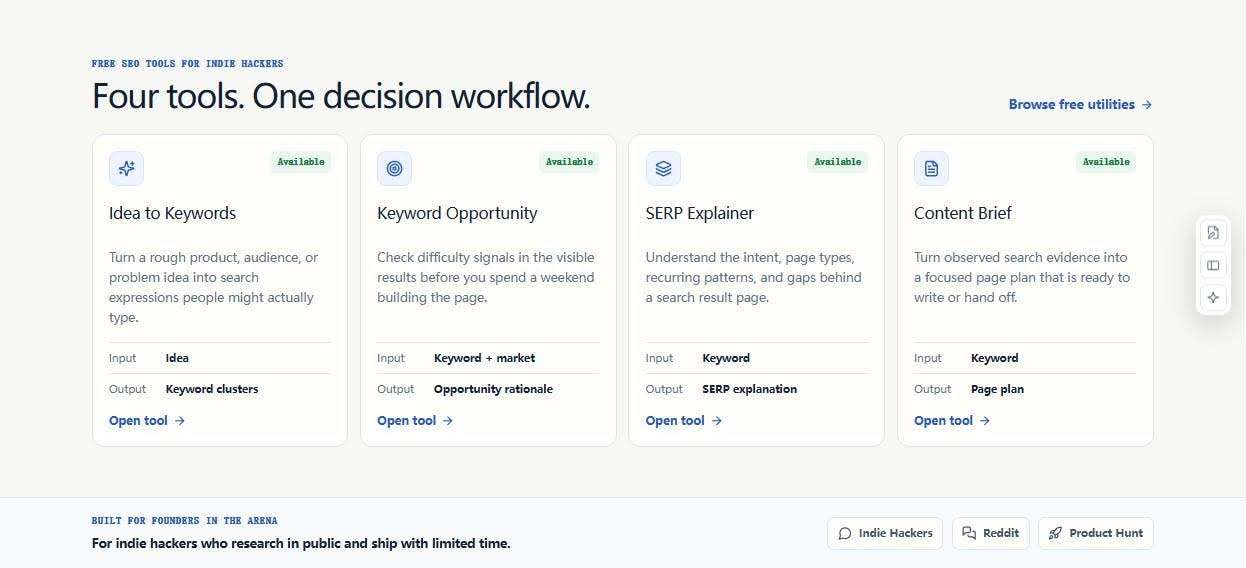
SerpStep is built around four connected tools that form a single decision workflow. Each one handles a specific question so you are never asked to juggle more than one problem at a time.
Idea to Keywords
You type in a product idea in plain language, not keyword-ese. SerpStep reads live result titles, Related Searches, and People Also Ask data to translate your founder language into the shorter, more specific phrases real users actually type into Google. It filters out navigational noise and fragments before grouping the remaining candidates by intent. The output is a focused shortlist, not a 500-row spreadsheet.
Keyword Opportunity
Before you spend a weekend building a page, this tool pressure-tests whether a keyword is worth targeting. It reads the current first-page result set, evaluates observable difficulty signals like domain diversity, result types, and dedicated pages, and gives you a triage score with the supporting evidence visible. Missing data is shown as unavailable, not silently swapped for a zero.

SERP Explainer
This is the tool that makes SerpStep genuinely different. It reads the first-page organic results returned for the query and tells you the dominant intent, the page formats Google is rewarding, recurring patterns across results, and only the gaps the available evidence can actually support. Instead of manually opening browser tabs and synthesizing notes, you get a structured market signal in one place. Every inference is labeled as an inference, which matters more than most tools admit.

Content Brief Generator
Once you know a keyword has a realistic opening, the Content Brief tool converts the SERP evidence into a production-ready page plan. It defines the page type, essential sections, the proof your content needs to include, and a concrete next action. You can export the whole thing as Markdown and hand it to a writer or use it yourself. No filler, no generic suggestions pulled from thin air.
How Marcus Used SerpStep on a Tuesday Morning
Marcus runs a one-person SaaS that helps freelance designers send client invoices. At 8:45 on a Tuesday, he sat down with one goal: figure out whether writing a landing page targeting “invoice template for designers” was worth his afternoon.
He had already wasted two weeks building a page for a different keyword, only to realize the SERP was dominated by massive template marketplaces he had no realistic chance of displacing. He was not about to repeat that.
He opened SerpStep, typed his idea into Idea to Keywords, and got a focused cluster of phrases back in under a minute. One of them, “invoice template freelance designer,” looked specific enough to be actionable. He ran it through Keyword Opportunity. The score came back at 45/100 — Medium — with a “MAYBE” verdict for a new site. More importantly, SerpStep showed its limits: the live SERP was available, but authority, traffic, backlink, and page-content evidence was not, so the result was explicitly labeled a SERP-composition read rather than a complete competitiveness measure.
Then he ran the SERP Explainer. Instead of inventing a gap, it returned a structural read of the page: 5 of 7 observed organic results were Guide/Article pages across 7 unique domains, and none of the seven titles used the complete query phrase. The existing results already served freelance and graphic-design invoice intent, while page-level content gaps remained unverified. That was useful in its own way: SerpStep was telling him what the SERP supported, not manufacturing an opening. He used that evidence to narrow the angle before generating his Content Brief. By 10:15, he had a Markdown brief in his editor built around a more defensible direction, rather than a guess about what competitors were missing.
How the SerpStep Workflow Actually Runs
Step 1: Start with an idea, not a keyword
Enter a product concept, audience problem, or outcome in plain language. SerpStep fetches live SERP signals and returns keyword clusters grouped by intent. No account needed for this step.
Step 2: Check the opportunity before you commit
Run your chosen keyword through Keyword Opportunity. Review the difficulty score and the observable signals that produced it. Decide whether the result set is worth deeper investigation or whether you should try a different angle.
Step 3: Read the SERP as a market signal
Feed the same keyword into the SERP Explainer. Get a structured breakdown of intent, page types, content patterns, and any gaps supported by the available evidence rather than guesswork.
Step 4: Export a brief and ship
Run the Content Brief tool. Review the page plan, export it as Markdown, and hand it off or start writing. The brief includes limitations so unsupported claims do not sneak into your draft.
SerpStep Pricing
There are three tiers, and the free one is genuinely usable:
- Free: $0/month, 1 keyword analysis per day, 1 content brief per month, SERP analysis, US market, no account required
- Starter: $12/month (founding member rate, locked in for the life of an uninterrupted subscription), 30 analyses per month, 10 content briefs per month, full SERP Explainer, browser-based analysis history, Markdown export, all supported markets, 7-day trial
- Pro: $29/month, unlimited analyses and content briefs (fair use), everything in Starter, Markdown and JSON export, priority support, 7-day trial
The $12 founding offer is worth noting. That rate is locked in for the life of an uninterrupted subscription, which is a meaningful difference from the typical “introductory price” that quietly expires.
Who Should Try SerpStep
If you are building something solo and your content strategy currently amounts to “write the thing and hope Google notices,” SerpStep is the most sensible place to start fixing that. It respects the constraint that you have limited hours and zero interest in becoming an SEO specialist. The free tier covers enough to validate whether the workflow fits how you think. Try it at serpstep.com and run your next keyword idea through it before you write a single word.