

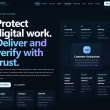



Most AI chatbots are glorified FAQ pages. They read your question, find a vaguely related answer, and leave you to do the actual work yourself. It’s a familiar frustration, and it’s one the team at Autom Mate clearly got tired of watching. Their answer is ChatPont, an AI agent platform built around a deceptively simple idea: answering a question is not the same as resolving a request.
ChatPont takes the conversation further. It connects to your helpdesk, CRM, Slack, WhatsApp, email, and a long list of other tools, then takes approved actions inside those systems. Open a ticket. Update a record. Send a tracking link. Escalate to a human with the full conversation history attached. The agent doesn’t stop at the reply box.
The platform is built on Autom Mate’s automation infrastructure, which means it comes with ISO 27001 certification and GDPR compliance out of the box. No engineers required to set it up, either. That’s a real claim, not a tagline. You can have an agent live in under ten minutes.
Key Features of ChatPont
Action Execution Across Connected Systems
This is the part that separates ChatPont from a standard chatbot. Once you connect your tools, the agent can create and update helpdesk tickets, process refunds via Stripe, look up order details, reset passwords, update CRM records, and trigger custom workflows. Every action runs within guardrails you define, so the agent only does what you’ve approved.
Multi-Channel Deployment from One Agent
You build the agent once. It runs everywhere. Website chat widget, WhatsApp, Microsoft Teams, Slack, email, and customer portals all share the same training and the same actions. Consistency across channels is automatic, not something you have to engineer separately for each one.
Knowledge and Document Intelligence
Training the agent is straightforward. Upload PDFs, paste a URL, sync your help center, or connect Google Drive. ChatPont indexes everything and uses it to ground every answer. On the Standard plan and above, it retrains automatically when your content changes, so the agent stays current without manual updates.
Smart Human Handoff with Full Context
When a request genuinely needs a human, the agent escalates without dropping the thread. The support rep receives the full conversation history, what actions were already taken, and any relevant customer context. No copy-paste. No starting from scratch. The handoff is clean.
Enterprise-Grade Governance and Audit Trails
Every conversation, action, and decision is logged. Role-based permissions, escalation rules, and audit visibility mean teams can run AI agents in production without losing oversight. This is particularly relevant for industries like insurance and IT service management, where compliance isn’t optional.

A Tuesday Morning at a SaaS Support Desk
Marta Kowalski runs support for a mid-size SaaS company. At 8:47 AM on a Tuesday, she sat down to find 34 new tickets had arrived overnight. At least a dozen were password reset requests, which her team handles manually by verifying the account and triggering a reset through their identity provider.
After connecting ChatPont to their Zendesk instance and their Azure Active Directory setup the previous week, she had set the agent to handle password resets autonomously within defined parameters. By 8:47, all 12 of those overnight tickets were already closed. The agent had verified each user’s account, triggered the reset, sent the confirmation email, and logged the action in Zendesk with a full audit trail.
Marta’s queue was 34 tickets. It became 22 before she had finished her coffee. The remaining tickets were escalations the agent had flagged correctly, billing disputes and access permission requests that needed a human decision. Those came through with all context already attached, so she could work through them quickly rather than hunting for account details.
That’s not a hypothetical. It’s the exact use case ChatPont was built for: high-volume, repetitive requests that follow a predictable pattern and pull focus from the work that genuinely needs a person.

How ChatPont Gets You to a Live Agent
Step 1: Train Your Agent
Start by pointing ChatPont at your knowledge sources. Drop in a URL, upload documents, sync your help center, or connect Google Drive. The agent learns your content, your tone, and the boundaries you set for what it should and shouldn’t answer.
Step 2: Connect Your Tools
This is where the action capability comes from. Link your helpdesk (Zendesk, Freshdesk, Jira Service Management, ServiceNow, TOPdesk, and more), your CRM (HubSpot, Salesforce), your payment processor (Stripe), and any messaging channels. The integration library is extensive and covers most common enterprise stacks.
Step 3: Define Approved Actions
Tell the agent what it’s allowed to do. Create a ticket automatically? Yes. Issue a refund up to $50? Requires approval. Escalate billing disputes? Always. These guardrails are what let you deploy an agent in a real support environment without anxiety.
Step 4: Deploy and Monitor
Launch across as many channels as you need. The analytics dashboard tracks conversations, actions taken, resolution rates, and escalations. You can tune behavior over time based on what you see.
ChatPont Pricing
There are four tiers, billed monthly or annually (annual saves 20%):
- Free: $0 forever, 1 agent, 50 message credits per month, 2 AI actions, 400 KB knowledge
- Hobby: $32/month (billed annually at $384), 500 message credits, 5 AI actions, 10 MB knowledge
- Standard: $120/month (billed annually at $1,440), 4,000 message credits, 8 AI actions, 20 MB knowledge, auto retrain
- Pro: $400/month (billed annually at $4,800), 15,000 message credits, 12 AI actions, 40 MB knowledge
No credit card is required to start. Enterprise plans with custom security and deployment options are available on request.
Worth Trying If You’re Done Babysitting Repetitive Tickets
ChatPont is built for support and operations teams that are tired of the same tickets showing up every morning. It works best when you have predictable, high-volume request types and a connected tool stack. The free tier is a genuine starting point, not a demo. If you want to see what an agent that actually closes tickets looks like, head to chatpont.com and build one this afternoon.