

Most personality tests end the same way. You answer a stack of questions, get slapped with a label, and receive a PDF that reads like it was written for a corporate onboarding packet. You nod along, maybe share it once, and never open it again. That’s not insight. That’s a filing cabinet.
discme takes a different approach. It’s built on the DISC framework, which covers four core behavioural traits: Dominance, Influence, Steadiness, and Conscientiousness. But instead of forcing you into one of four boxes, it maps you to one of 16 profiles, including blended types that capture the nuance most tools quietly skip over. The result actually reads like a description of a real person.
What makes it stand out even more is what happens after the test. The profile evolves. There’s a relationship overlay for comparing your type with a partner or friend. And there’s Ask discme, an AI that already knows your personality before you type a single word. More on that shortly.
What discme Actually Does: Key Features Worth Knowing
16 Blended Profiles, Not Just 4
Traditional DISC tools give you one dominant trait and call it done. discme recognises that when two traits score close in strength, you get something genuinely distinct. The Inspiring Driver (ID blend) is not the same as a pure D or a pure I. The Careful Supporter experiences the world differently from a plain S or C. Each of the 16 profiles gets its own name, description, and set of insights, written in plain English with no jargon. The test takes about 8 minutes and 60 questions, and no account is needed to start.
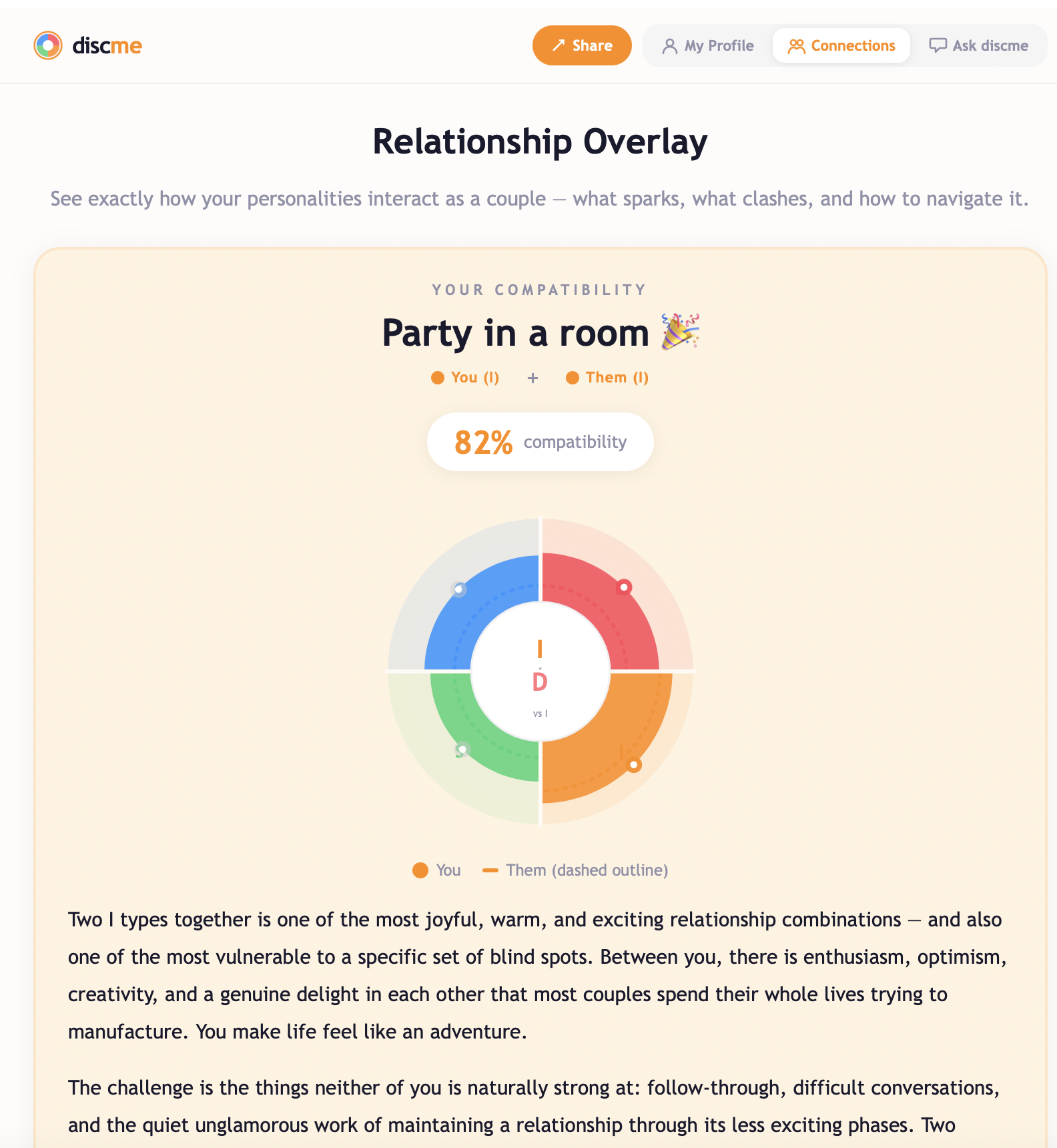
The Relationship Overlay
You can add a partner, friend, or colleague and get a tailored compatibility report for that specific relationship. It shows where you complement each other, where friction tends to build, and how to navigate those differences. The report is grounded in real psychological patterns, not a generic score out of ten. It’s the kind of thing you actually want to send to someone.
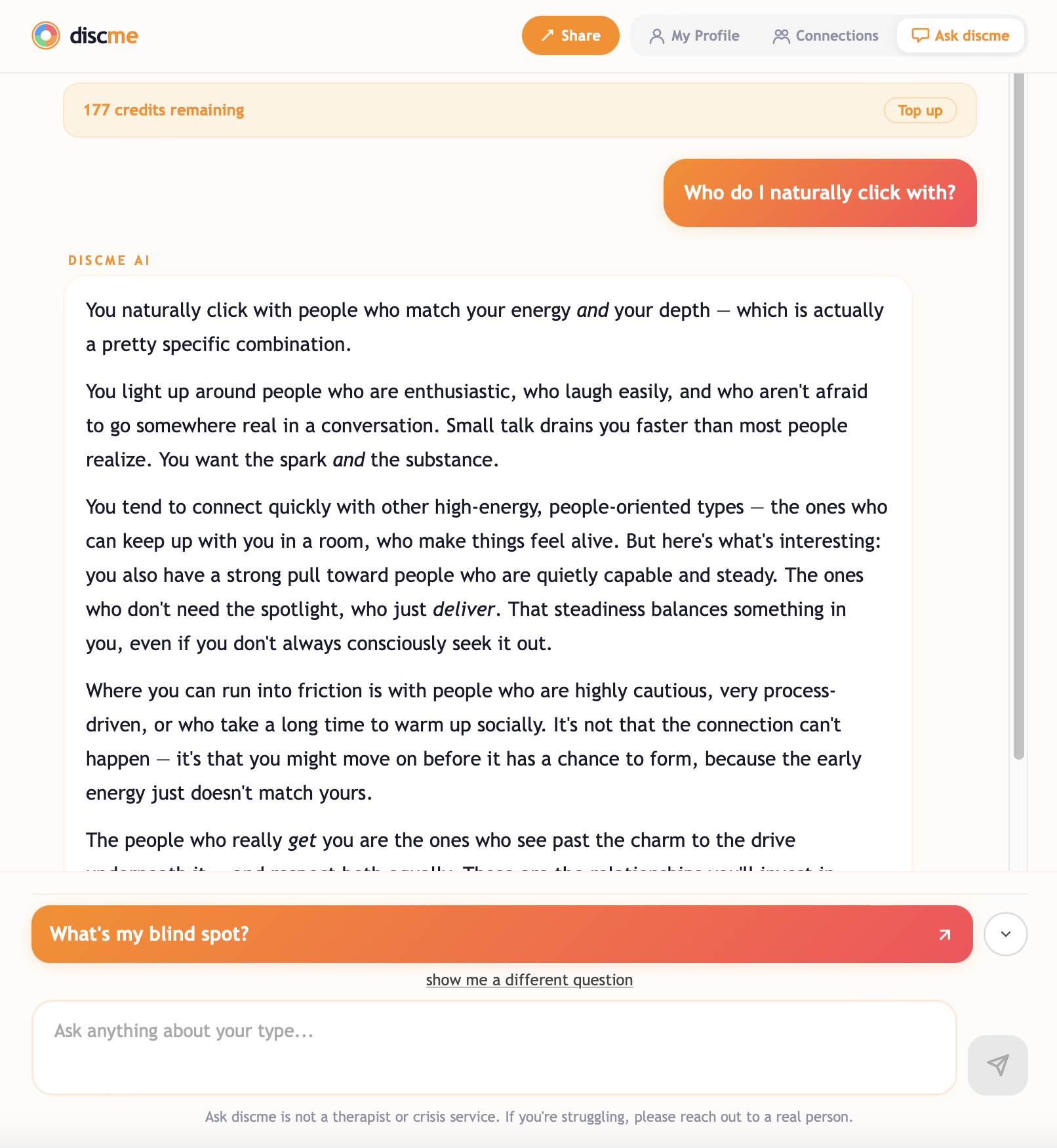
Ask discme: AI That Already Knows Your Type
Most AI chatbots treat every user identically. Ask discme doesn’t. Because it already has your profile, every answer it gives is shaped around how you think, what you need, and how you process information. A D type asking about conflict will get a completely different response than an S type asking the same question. It’s a small detail with a big impact on whether the advice actually feels relevant.
Weekly Nudges Built for Your Type
Each week, discme sends a prompt specific to your profile. Not generic productivity advice. Something that only makes sense if you’re your type: something to notice, something to try, something to sit with. It’s how the tool stays useful long after the initial result.
How Priya Used discme to Stop Misreading Her Colleague
Priya is a product manager at a mid-size SaaS company in Manchester. She’d been working alongside a developer called James for six months, and the dynamic was consistently frustrating. She moved fast, made quick calls, and wanted progress. James wanted to check every detail before committing to anything. She assumed he was being difficult. He assumed she was being reckless.
At 9pm on a Tuesday, after another meeting that went sideways, Priya took the discme test. Her result: The Inspiring Driver, an ID blend. She sent James the link. He completed it the following morning and came back as a CS blend, The Careful Supporter.
She pulled up the relationship overlay. The report didn’t just confirm they were different. It explained exactly why her urgency read as pressure to him, and why his caution read as obstruction to her. It gave specific language for navigating that gap. By Friday’s planning session, Priya tried one suggestion from the report: framing decisions with more lead time and fewer open-ended questions. James visibly relaxed. The meeting finished ten minutes early.
She didn’t need a team workshop or a consultant. Eight minutes of honest answers and a compatibility report did the work.
How the discme Profile Actually Gets Built
Step 1: Take the 8-Minute Test
No account required. You answer 60 questions about how you naturally behave, not how you’d like to behave. The test is designed to reflect real tendencies, so answering honestly matters more than answering impressively.
Step 2: Get Your Blended Profile
Your result maps you to one of 16 profiles. You get four tabs to explore: Overview, Strengths, Relationships, and Growth. Each is written in clear, direct language, no HR buzzwords, no vague affirmations.
Step 3: Add Connections and Compare
Send the test link to someone in your life. Once they complete it, the relationship overlay generates a compatibility report specific to your combination. You can add multiple connections across different contexts.
Step 4: Keep Using It
Save your profile with an email address and Ask discme becomes available for ongoing questions. Weekly nudges arrive based on your type. The profile is designed to stay relevant over time, not just on the day you take the test.
Who discme Is For and Where to Try It
If you’ve taken a DISC assessment before and found it dry or forgettable, discme is worth another look. It suits anyone who wants to understand their own patterns better, whether in relationships, at work, or just for self-awareness. The core test and full profile are free with no account needed. Ask discme credits cost extra, but the base experience stands on its own.
You can start right now at discme.app. No sign-in, no friction. Just answers that might actually surprise you.